At a glance
- Agentic commerce means AI agents find, compare and sometimes buy products for shoppers; as of November 2026 it is real for discovery and still early for checkout.
- AI agents compare brands on price, delivery and reviews, so they tend to win the first purchase on terms any competitor can match.
- Adobe measured AI traffic to US retail sites up 71% year over year in September 2026, converting 90% better than non-AI traffic.
- A native mobile app is where the next purchase starts with your brand instead of with the agent, which is why agentic commerce raises the value of every app install.
Most ecommerce leaders now accept that agentic commerce will change how people shop, and many conclude that a mobile app matters less once an AI agent does the shopping. The opposite holds. Agentic commerce is shopping in which AI agents such as ChatGPT and Google's Gemini research, compare and sometimes buy products on a shopper's behalf. It moves discovery to the agent, and the agent compares your brand with everyone else on price, delivery and reviews every time it is asked. The next purchase only starts with you when the customer comes straight back. A native mobile app is built for that moment: the customer is already signed in, sees your brand and hears from you first.
What agentic commerce means for ecommerce brands
Agentic commerce is a model of online shopping in which an AI agent acts for the shopper: it interprets a request, searches across stores, compares options and, where the shopper allows it, completes the purchase. For ecommerce brands, it means a growing share of product discovery happens inside assistants they do not run, before a shopper ever reaches their website or app.
McKinsey describes three ways this plays out: an agent working directly with a merchant's site, a shopper's agent dealing with the merchant's own agent, and a broker platform sitting in between. It estimates that agentic commerce could orchestrate $900 billion to $1 trillion in US B2C retail revenue by 2030. The range is wide and the timing uncertain, but the direction is clear: the first conversation about a purchase increasingly happens somewhere the brand does not control.
Two open protocols carry most of this activity. OpenAI and Stripe introduced the Agentic Commerce Protocol (ACP) in September 2025, and Google introduced the Universal Commerce Protocol (UCP), built with Shopify, Etsy, Wayfair, Target and Walmart, in January 2026. Both are open standards that let AI agents complete purchases with merchants. Most brands reach them through their commerce platform or payment provider rather than building them, which is why step 1 of the Bring-Them-Home Loop starts with the platform's agentic channels.
What does not change is who fulfills the order and who the customer chooses to come back to. That second question is where a mobile app does its work.
What is real in agentic commerce in 2026, and what is still early
AI-assisted discovery is real and growing fast in 2026, while AI agents completing checkout on their own is still early. The clearest evidence of the year points the same way: shoppers use agents to find and compare, then mostly buy from the merchant, and the AI platforms have adjusted their products to match that behavior.
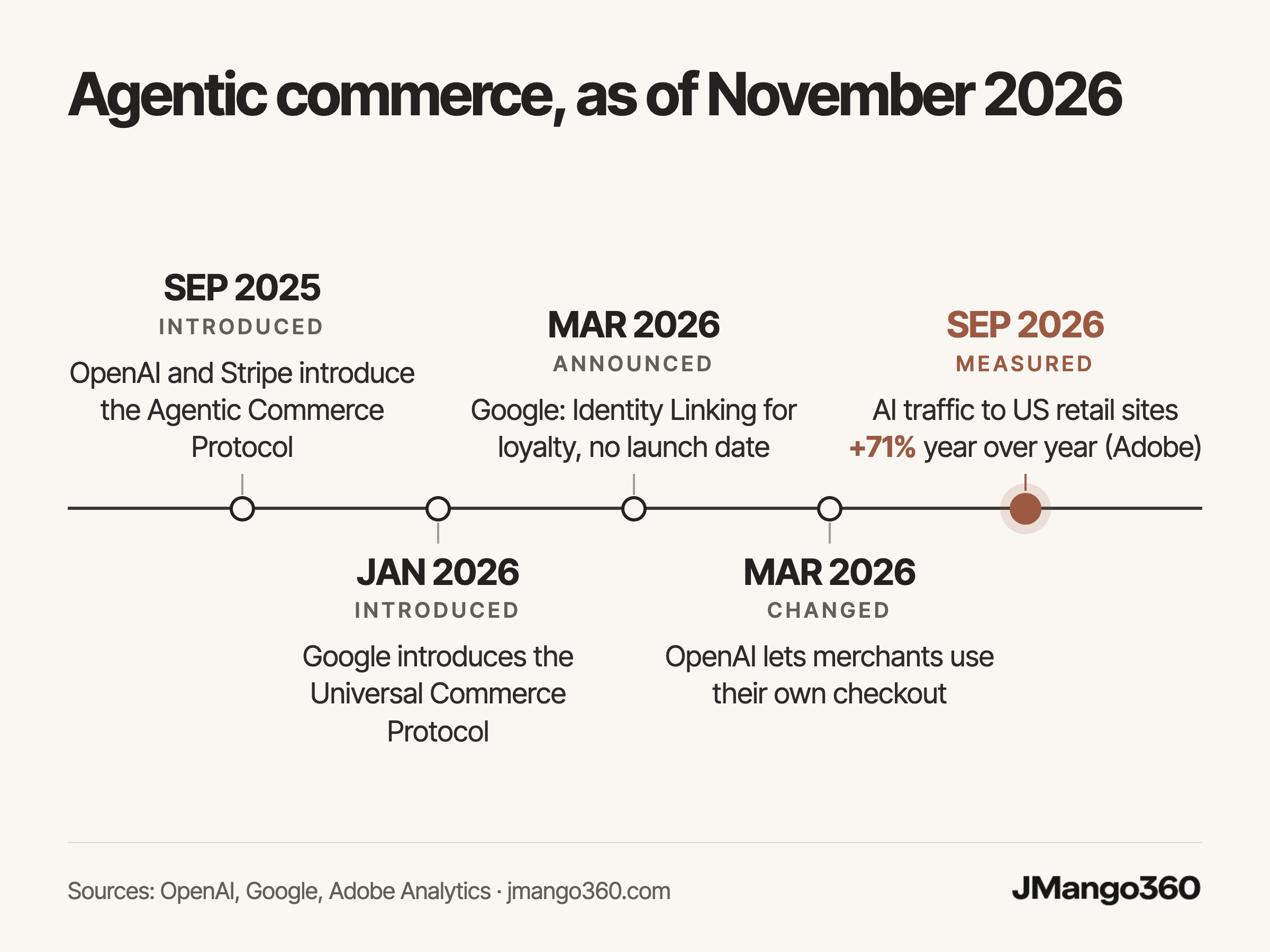
- Discovery is real. In September 2026, AI traffic to US retail sites grew 71% year over year, and those visits converted 90% better than non-AI traffic, according to Adobe Analytics. Shoppers who arrive from an agent are close to buying.
- In-chat checkout stepped back. On March 24, 2026, OpenAI said the first version of ChatGPT's Instant Checkout lacked the flexibility it wanted, and that it is "allowing merchants to use their own checkout experiences" while it focuses on product discovery.
- Loyalty is starting to move into agents. On March 19, 2026, Google announced that its Universal Commerce Protocol (UCP) will support Identity Linking, so shoppers in AI Mode and the Gemini app can receive the same loyalty or member benefits they get when logged in on a retailer's site. The announcement gave no launch date.
- Trust in autonomous buying is limited. In Riskified's Q1 2026 survey of 2,000 shoppers in the US and UK, 55.0% said they are not comfortable with AI agents making purchases on their behalf.
The hype was that agents would replace the store. The reality in November 2026 is that agents replace much of the browsing, then hand the shopper to a merchant. Where that handoff lands decides who keeps the customer.
Agentic commerce vs traditional ecommerce: what changes for brands
Agentic commerce differs from traditional ecommerce in who does the shopping. In traditional ecommerce, search, ads and social sent shoppers to the brand's site, where the brand made its case. In agentic commerce, an AI agent researches, compares and shortlists in a chat, so the brand is judged on comparable facts before the shopper arrives. The brand's app is the one part of the journey the agent does not replace.
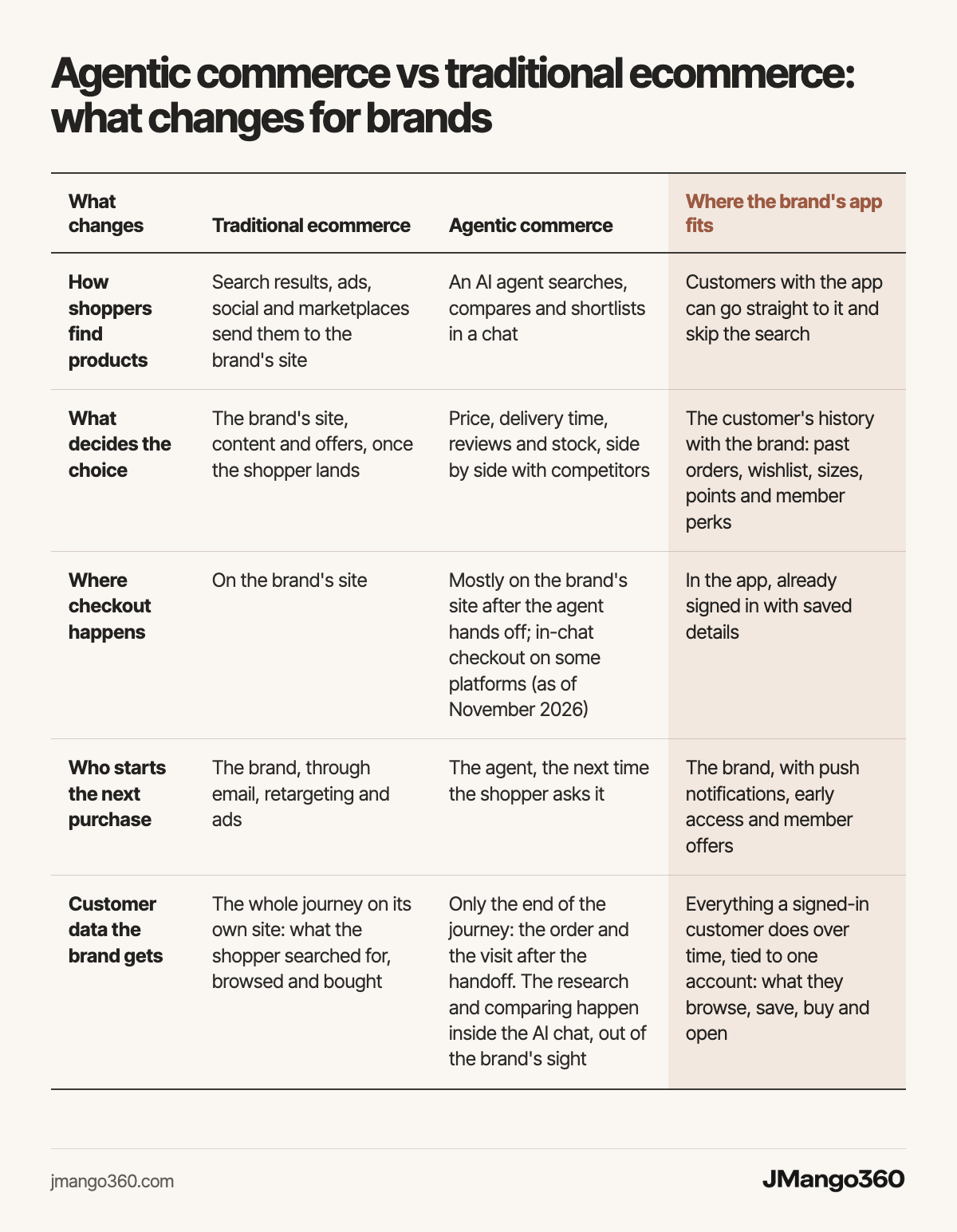
The table is not an argument against agents. A brand needs both: agents to be found by new shoppers, and the app so it does not pay to win the same shopper twice. The last row matters most over time, because the signed-in behavior an app collects is the first-party data that powers the brand's own personalization.
Why agentic commerce makes your mobile app more valuable
Agentic commerce makes a mobile app more valuable because it makes every purchase that starts outside the app more contested. When an agent shortlists brands for each request, loyalty becomes conditional, and the customers who open your app first are the ones you no longer have to win again through an agent.
Accenture's 2026 Consumer Pulse research, a survey of 25,590 consumers in 16 countries, shows how conditional that loyalty already is: 37% of behaviorally loyal consumers would let an AI agent switch brands for a better fit. The same research found consumers more than twice as likely to trust brand- or retailer-owned agents as AI-native platform agents. A brand's own environment still carries trust. What matters is whether the customer is in it when the next need comes up.
That is why the value of an app concentrates in a loyal core. Repeat customers buy most often, open messages and respond to drops. When agents compete for every first purchase, those customers are worth more, and the app is where a brand reaches them without an intermediary — the core of why an app pays for brands with repeat customers.
In practice: Vlisco, a JMango360 client whose Dutch wax-print fabrics originated in 1846, saw almost 20% of total online revenue generated by 8.1% of users after 3 months with its app. Studio Anneloes, a premium apparel brand and JMango360 client, sees customers spend about 10 minutes in the app — 6× the time on its mobile website. Both show the same pattern: a small installed group carries an outsized share of revenue and attention, and that is the group agentic commerce makes harder to win back.
The Bring-Them-Home Loop: from AI discovery to app customer
The Bring-Them-Home Loop is a four-step way to turn the shoppers AI agents send you into customers who start their next purchase in your app. The first two steps happen wherever the agent sends the shopper; the last two happen in the app, and they are where the relationship is kept.
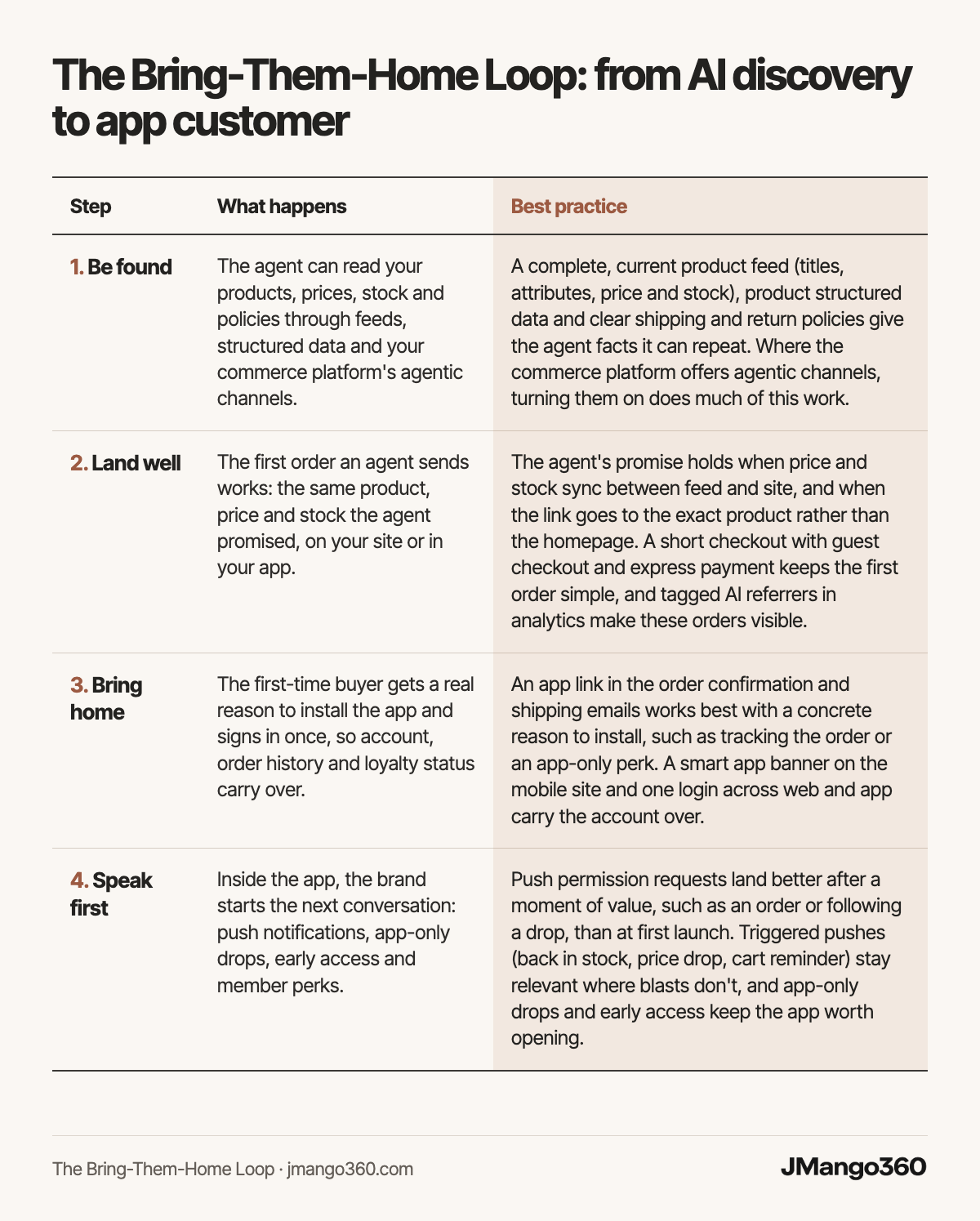
Most agentic commerce guides stop at step 1. Steps 3 and 4 are where an app earns its place, and they mirror how we work at JMango360. As a specialist ecommerce mobile app partner, we build, launch and grow native iOS and Android shopping apps for established ecommerce brands across any commerce stack: a launch plan with App Store optimization and first push campaigns before go-live, then a dedicated success manager and regular performance reviews after it, so brands don't have to build that capability in-house.
What your app needs for agentic commerce
A mobile app is ready for agentic commerce when it can take a shopper the agent found and keep them: it opens from a link, recognizes the customer, shows their status and gives them a reason to stay. These capabilities sit in the app and the commerce stack, not in a new AI feature.
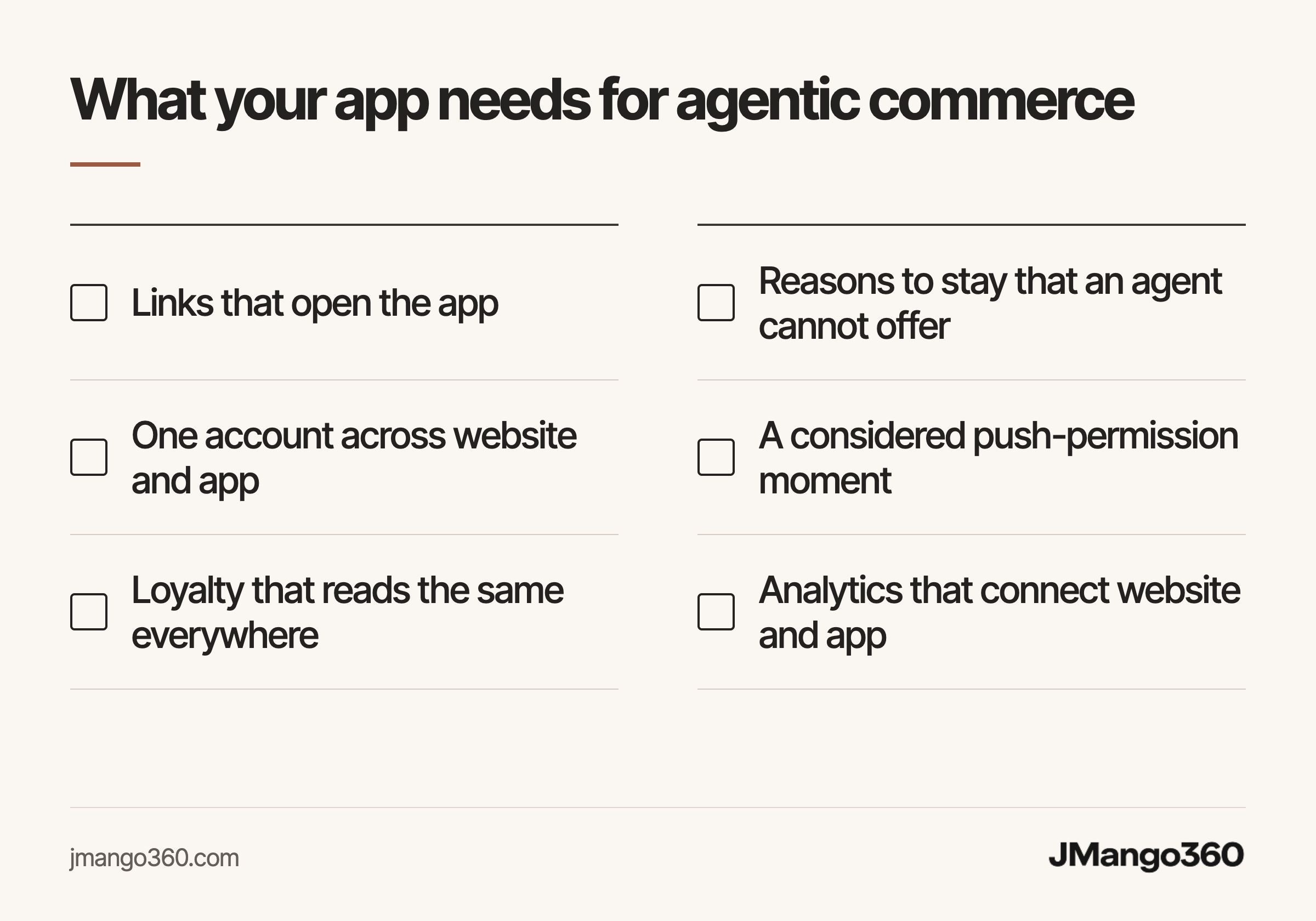
- Links that open the app. When a customer who has your app taps a product link in an email or a message, the product opens in the app instead of a browser tab. Universal Links on iOS and App Links on Android make this possible when they are set up for your domain.
- One account across website and app. A customer who first bought on your website after an agent's recommendation signs in to the app with the same account and finds their order history.
- Loyalty that reads the same everywhere. Points, tier and member pricing match across the agent, the website and the app, which usually means the app reads them live from the loyalty platform, such as LoyaltyLion or Smile.io.
- Reasons to stay that an agent cannot offer. App-only products, early access to drops and member perks give a customer a reason to open the app before asking an agent.
- A considered push-permission moment. The app asks for notification permission when the value is obvious, such as after an order or when a customer follows a drop.
- Analytics that connect website and app. GA4 does not carry a shopper's earlier website referral into the app on its own. Tagging app and store links with campaign parameters, and using one customer ID across website and app, lets the team see which app customers first arrived through an AI answer.
When an app cannot do these things yet, the useful questions for the app provider are specific: do product links open the app on both iOS and Android, can customers use one login across web and app on our commerce platform, are loyalty balances live in the app, and can products or collections be flagged as app-only?
How to prepare for agentic commerce: what to do next
Preparing for agentic commerce means working on both ends of the Bring-Them-Home Loop at once: being readable for agents and being worth coming back to. Most brands are further behind on the second end, and much of it is CRM and content work that can begin before any app roadmap changes.
Work the marketing and ecommerce team can start now
- Segmenting AI-referred customers in analytics (referral sources such as chatgpt.com, perplexity.ai and gemini.google.com) shows how many first orders already start with an agent.
- Adding an app invitation to the order confirmation and first post-purchase emails matters, because for an agent-sent buyer those are often the first messages from the brand itself.
- Deciding which products, drops or perks will be app-only gives the app a reason to install that no agent can match.
- Testing how your top products appear in ChatGPT, Gemini and Google AI Mode shows what shoppers are told before they reach you.
Work for the next app roadmap
- Product links that open the app on iOS and Android mean customers who already have the app land in it rather than in a browser tab.
- One account and live loyalty status across website and app mean an agent-sent first order and its points are waiting when the customer signs in to the app.
- A planned push-permission moment and a first app-only campaign give new installs a reason to accept notifications and to come back.
- App analytics that link each app customer to the channel that first brought them in, through tagged links and one customer ID across website and app, show whether AI-found customers stay.
Agentic commerce is real for discovery and still early for checkout (as of November 2026). AI agents will win more first purchases on price, delivery and reviews; our advantage is the next purchase. Our plan is to stay readable for agents, then bring AI-found customers into our app, where they are signed in, see our brand and hear from us first. We will track how many first orders come from AI referrals and how many of those customers install the app.
Frequently asked questions
Do ecommerce brands still need a mobile app if AI agents do the shopping?
Ecommerce brands with repeat customers need a mobile app more, not less, as AI agents do more of the shopping. Agents compare every brand on price, delivery and reviews each time a shopper asks, so loyalty becomes conditional. A native app keeps loyal customers signed in, shows them the brand and lets the brand start the next conversation with push notifications and app-only offers. Brands that sell mostly one-off, price-led products gain less.
Should a brand build a ChatGPT app instead of a mobile app?
A ChatGPT app and a mobile app do different jobs. A ChatGPT app places a brand inside the assistant where shoppers search; Walmart's app in ChatGPT, for example, supports account linking, loyalty and Walmart payments (OpenAI, March 2026). Shoppers still have to find and open it inside ChatGPT. A mobile app lives on the customer's home screen and lets the brand reach that customer directly. Walmart runs both; the mobile app is the one it owns.
How can a brand see whether AI agents already send it customers?
A brand can see AI-referred customers by filtering analytics sessions and orders by referral source, such as chatgpt.com, perplexity.ai, gemini.google.com and copilot.microsoft.com. Comparing those customers' repeat-purchase and app-install rates with other channels shows whether AI-found shoppers stay. Order data from the commerce platform completes the picture for purchases that leave little trace in website analytics.
Does Google's Identity Linking make a loyalty app unnecessary?
Google's Identity Linking does not make a loyalty app unnecessary; it is designed to make loyalty status portable. Announced for the Universal Commerce Protocol in March 2026, it will let shoppers receive member benefits in AI Mode and Gemini from retailers that integrate it. The shopper still starts in Google's environment, where the brand is one option among several. The app remains the place where the customer starts with the brand and where the brand can speak first.
Agentic commerce and your mobile app: found by AI, kept in the app
Agentic commerce changes where shopping starts, not which brands customers come back to. In 2026 AI agents are a real and fast-growing discovery channel, checkout mostly stays with the merchant, and loyalty is being built into agents. Every one of those shifts makes the first purchase more open to competition and the next purchase more valuable.
The brands that gain are the ones that let agents find them and give the customers those agents send a reason to come home. A native mobile app is that home: the customer is signed in, sees the brand and hears from it first, without an agent in between.
Three next steps follow from that. Measuring AI-referred first orders comes first, because the size of the channel sets the urgency. Turning the first post-purchase messages into an app invitation comes second, because for an agent-sent buyer those are the first direct contact. Closing gaps in links, login and loyalty comes third, because each gap breaks the Bring-Them-Home Loop.
To see what bringing AI-found customers into an app could add to your revenue, the Mobile Revenue Scan gives a modelled business case: projected revenue uplift, payback period and comparable results.