At a glance
- Whether to fix or rebuild an ecommerce app depends on four questions (code health, stack fit, roadmap fit and user continuity), not on the app's age.
- As of October 2026, App Store uploads must be built with Apple's latest developer tools (Xcode 26) and Google Play updates must target the latest Android version (Android 16), so an unmaintained app falls behind regardless of code quality.
- Misdiagnosis is costly both ways: patching an outgrown app keeps paying for the same problems, while rebuilding one that mainly lacked an owner recreates them.
- A phased rebuild keeps the current app selling while its foundations change, and any route only holds if someone owns the app after launch.
Your shopping app still takes orders, but every release has become a negotiation. When you weigh whether to fix or rebuild your ecommerce app, the development team argues for starting over, the budget holder wants the current app repaired, and nobody can show which path costs less. The short answer is that it makes sense to repair a legacy ecommerce app when its foundations still fit your store, your roadmap and the customers who use it, and to rebuild when they do not. Fixing means repairing the existing app and refactoring it (restructuring the code so it is easier to maintain, without changing what customers see) within its current architecture. Rebuilding means replacing the codebase (the app's underlying source code) while keeping, wherever possible, the listings, users and data around it. This article covers the four questions, three routes and the leadership case.
Why ecommerce apps reach the fix-or-rebuild point
Brands rarely replace a mobile app because its code got old. They reach the fix-or-rebuild point when the app falls behind three things that keep moving (Apple's and Google's platform requirements, the commerce stack behind the website and the brand's own roadmap) and nobody is responsible for keeping up.
The first runs on a calendar the brand does not control. According to Apple's developer requirements, apps uploaded to App Store Connect have had to be built with Xcode 26 (Apple's app-building software) and a 26-series SDK (software development kit: the tools and code libraries an app is built with) since 28 April 2026, after similar cutoffs in April 2023 and April 2024. Google Play's target API rules require new apps and app updates to target the latest Android version (Android 16) from 31 August 2026. These iOS and Android update requirements for shopping apps matter because an app that cannot be built with current tools cannot ship any update, not even a checkout fix.
The second is the store itself. A native app reads its catalogue, prices, accounts and checkout from the same commerce platform as the website. So when the web team changes promotion logic or connects a new Klaviyo flow or loyalty programme, the app's data changes too. An app built with shortcuts around that data collects a patch after every web change, and failures surface at checkout, where they cost revenue and ratings fastest.
The third is ownership. Many apps launch as a project and are then left without anyone responsible for OS updates and integrations, so the question gets forced by a deadline or an outage. That is often when brands start looking for ecommerce app rescue, and when misdiagnosis is most likely.
Four questions that decide fix or rebuild
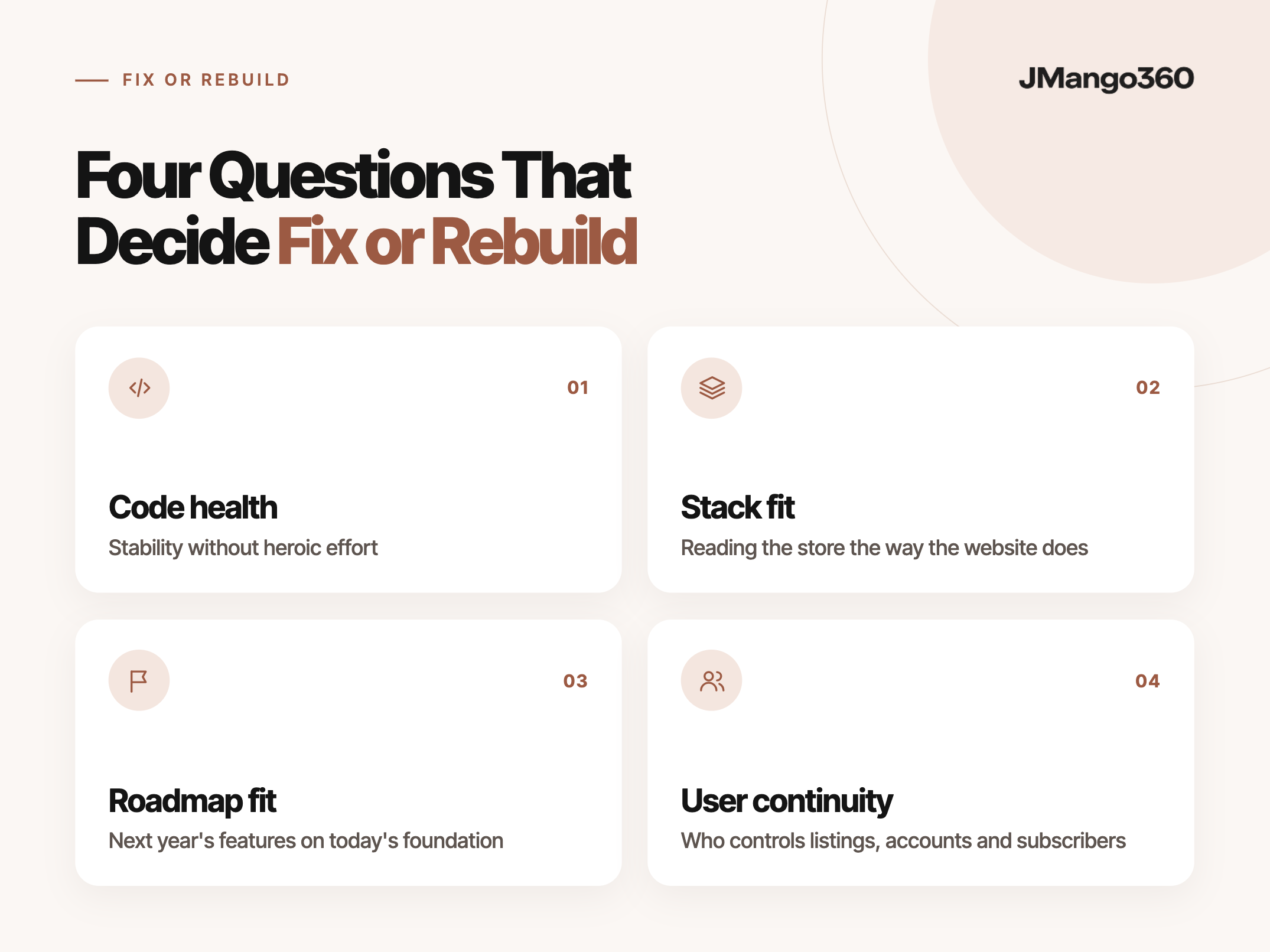
Four questions show when to rebuild an ecommerce app and when repair is enough. When code health, stack fit, roadmap fit and user continuity agree, the decision is usually clear. When they split, a phased route tends to fit better than either extreme.
Code health: stability without heroic effort
Code health is where most teams start, and the useful signal is the pattern of defects, not their number. When the same class of failure (a cart that empties, or a crash on one OS version) returns after each release, the cause is structural and patches only treat the surface.
Google offers a measurable line. Its Android vitals guidance sets overall bad-behaviour thresholds of a 1.09% user-perceived crash rate and a 0.47% user-perceived ANR rate (ANR stands for Application Not Responding: the app freezes and stops reacting to taps). Above them, Google Play may reduce the app's visibility and show a warning on its store listing. Stability is a sales issue too.
Stack fit: reading the store the way the website does
Stack fit decides how much every future fix will cost. An app that reads Magento / Adobe Commerce, BigCommerce or Shopify Plus live, using the website's catalogue, stock and customer data, tends to break less than one that keeps its own copies. Duplicated logic drifts with every web release, which is where mismatched prices and broken checkouts usually come from.
Roadmap fit: next year's features on today's foundation
A stable, well-connected app can still be the wrong foundation for where the business is heading. A useful test is whether next year's planned features, such as in-app loyalty, B2B pricing or several stores in one app, can be built without workarounds. McKinsey compares technical debt, the cost of shortcuts that build up in an app's code over time, to a loan. The principal is the work needed to modernise the app, and the interest is the extra time and complexity every new project costs while that work stays undone. When most roadmap items carry that interest, fixing becomes the expensive option.
User continuity: who controls listings, accounts and subscribers
Continuity often makes a rebuild feel impossible, yet it is the easiest question to answer with facts. Whether a rebuilt app reaches customers as an update rather than a new download depends largely on who owns the App Store and Google Play listings and developer accounts. It also depends on whether login, push and analytics data can carry across. When the brand controls those assets, a rebuild changes the code, not the customer relationship that installs, ratings and push subscribers represent.
Fixing, rebuilding or phasing: three routes compared
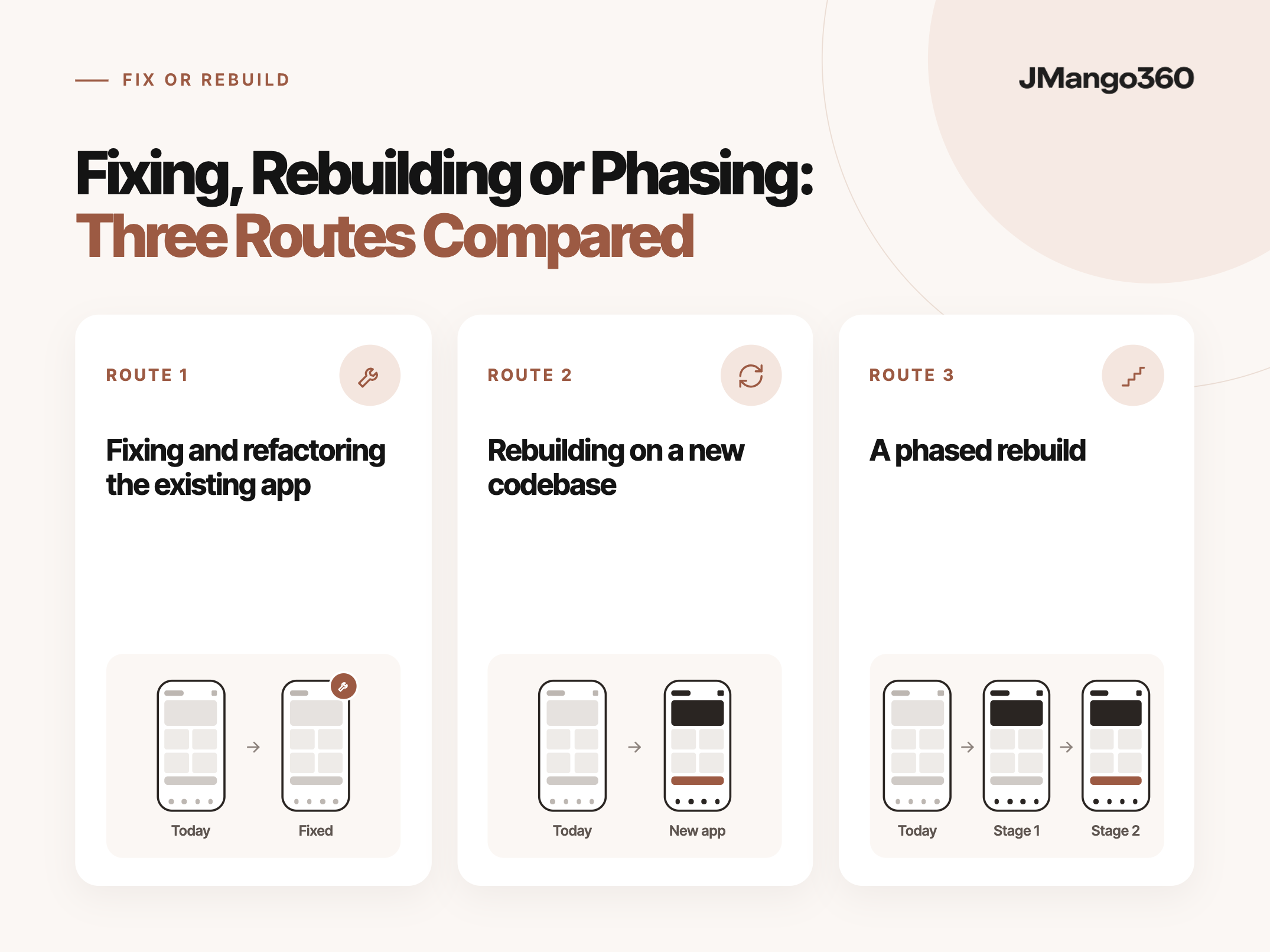
The four answers point to one of three routes, so the rebuild vs refactor ecommerce app debate is rarely binary. Each route fits a different pattern of answers, and only the phased route is designed to keep the current app selling while its foundations change.
Route 1: Fixing and refactoring the existing app
Fixing means repairing defects, refactoring (restructuring) the weakest code and updating the app's development kits (SDKs) to current requirements within the existing architecture. It suits an app that is healthy at its core and connects cleanly to the commerce platform.
Customers keep the app they know, but this route breaks down when defect classes keep returning or the roadmap outgrows the structure, because each fix then adds interest.
In short
- Best when: The code is stable at its core and already reads the commerce stack cleanly.
- Main risk: Fixes keep recurring because they never reach the structural cause.
- What it protects: Your existing listings, ratings, users and release history stay intact.
- Who carries it after launch: The previous owner keeps it, so closing the ownership gap has to be part of the fix.
Route 2: Rebuilding on a new codebase
Rebuilding replaces the codebase with one built against current Apple and Google requirements and designed around the commerce stack the brand runs today. It suits an app that fails on stack fit or roadmap fit.
The price is that every existing behaviour, including undocumented edge cases, has to be recreated and every integration retested. The roadmap often slows during the build, and continuity planning becomes part of the scope.
In short
- Best when: The app fails on stack fit or roadmap fit, and the brand controls its listings and data.
- Main risk: Behaviour the old app handled quietly can go missing in the new one.
- What it protects: The next several years of roadmap get a foundation that fits the store.
- Who carries it after launch: An owner agreed before the build starts.
Route 3: A phased rebuild
A phased rebuild replaces the app in stages, by customer journey or scope, so the live app keeps earning while each stage proves itself. It suits split answers and revenue-heavy apps, which makes it the usual way to repair a legacy app without disrupting sales.
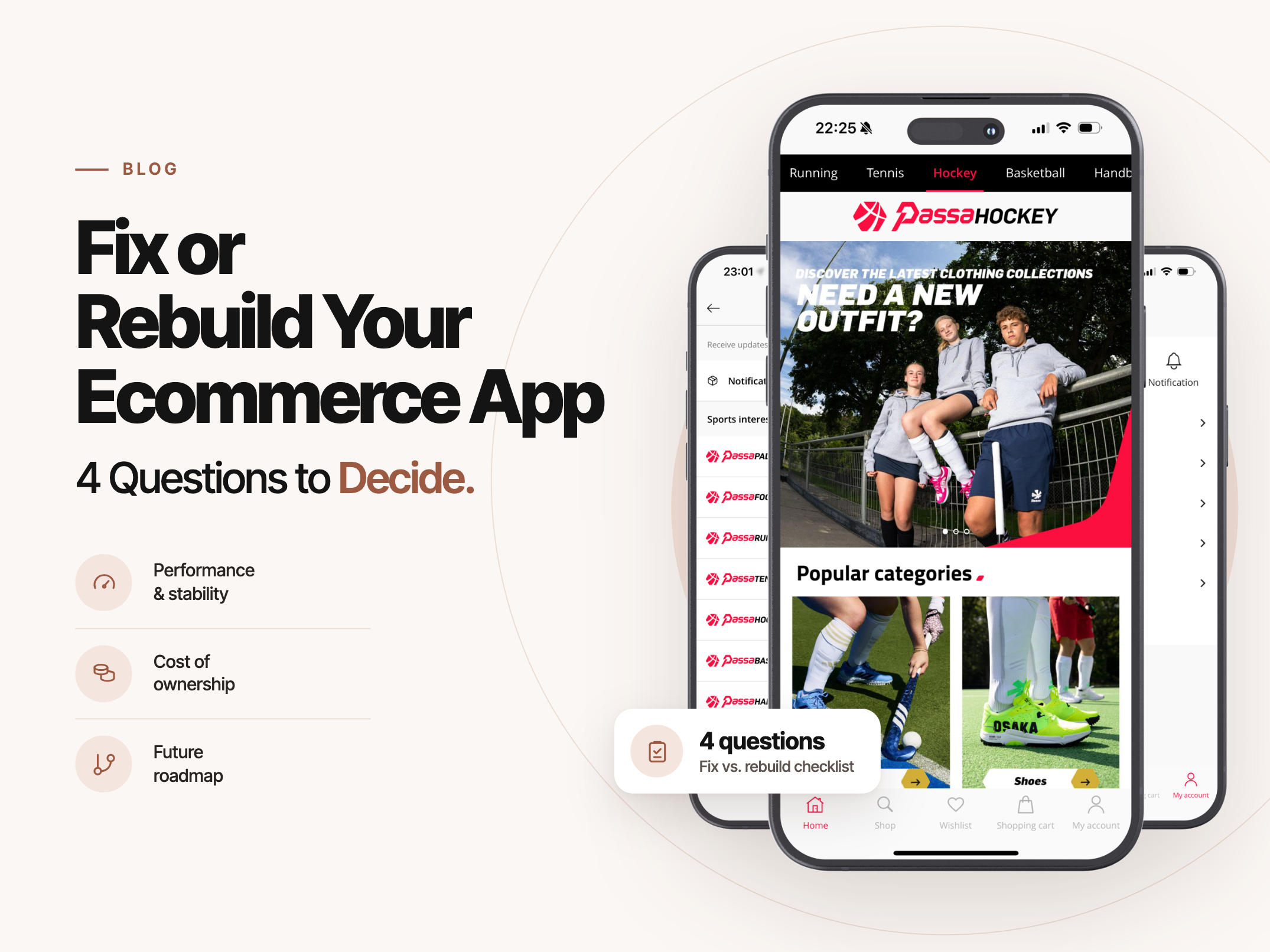
Phasing applies to scope, not only to code. PassaSports, a JMango360 client specialising in nine sports from running to padel, saw customers shopping across its sport-specific shops. It merged nine sport-specific shops into one app with a single checkout, starting with two sports, and all labels were integrated within a few months. In a rebuild, a narrower first release works the same way: the team learns while sales continue.
In short
- Best when: The four answers split, or a large share of revenue runs through the app.
- Main risk: Old and new parts can run side by side for too long if stages are not tightly scoped.
- What it protects: Sales and customer habits continue throughout the transition.
- Who carries it after launch: One owner across all stages, so each release builds on the last.
Making the business case: cost, risk and continuity
Once the route is clear, it still needs approval. Leadership approves more readily when the choice is framed as an investment, the cost of keeping the current app alive against the cost of replacing it. A repair bill set against a build quote hides what each option protects.
An honest ecommerce app rebuild cost depends on drivers, not a price list: integrations, custom features, continuity work, any period of running two apps in parallel, and your team's own time. Naming them early keeps quotes comparable. JMango360's pricing page lists similar drivers under what shapes the investment in an ecommerce app.
Doing nothing also has a cost, with dates attached. Under Google Play's requirements, existing apps must target at least the previous Android version (Android 15) to stay available to new users on newer Android devices. Apple's cutoff blocks updates from apps built with older tools.
In a McKinsey survey of 50 CIOs at financial-services and technology companies with revenues above $1 billion, conducted in July 2020, CIOs reported that 10 to 20 percent of the technology budget for new products was diverted to resolving tech-debt issues. They also estimated tech debt at 20 to 40 percent of the value of their technology estate. McKinsey adds that once tech debt exceeds 50 percent of a division's tech asset value, the risk and cost of existing systems start to outweigh their benefits, and it warns against big-bang write-offs. The figures come from large enterprises, but the framing fits a shopping app.
The most useful format for leadership is three scenarios, each with its time, risk, continuity and an agreed success measure. For stability, Google's 28-day Android vitals window is a ready-made before-and-after test.
Why either decision needs an owner after launch
A rebuild nobody owns afterwards becomes the next legacy app. Fixing or rebuilding resets the app's condition, not its trajectory. Without an owner for yearly OS and store changes, integration updates and performance reviews, the same question returns a few release cycles later.
Ownership covers recurring work: meeting Apple's and Google's new requirements, adapting the app when the platform or integrations change, and reviewing what the app contributes to revenue. Whichever team or partner you choose, these items are worth putting in writing.
JMango360's published model shows one way to cover it. The monthly fee covers the platform licence, including iOS and Android updates and app store compliance, plus support and SLA. Launches are followed by weekly calls throughout the first four months, a 90-day assessment and a dedicated success manager. The full model is set out in how JMango360 builds, launches and grows ecommerce apps.
Frequently asked questions
Will customers have to download the app again if we rebuild it?
Not necessarily. Whether a rebuilt app reaches customers as an update to the app they already have depends largely on who owns the App Store and Google Play listings and the developer accounts behind them. When the brand controls those, a rebuild can usually be planned around the existing listing. When a previous provider controls them, ownership has to be resolved first. Confirming who holds those accounts is worth doing before any rebuild is scoped, because it shapes the whole plan.
Is it cheaper to fix an ecommerce app than to rebuild it?
Fixing is usually cheaper upfront, which is why it is often the default choice. The total cost depends on whether fixes keep recurring and on what the roadmap needs next. If the same defects return after each release, or planned features require workarounds, the repair budget keeps growing while the underlying problem stays in place. Comparing the next two or three years of expected fixes with the cost of a rebuild or a phased rebuild gives a fairer picture.
Which update requirements do Apple and Google enforce on shopping apps?
As of October 2026, Apple requires apps uploaded to App Store Connect to be built with Xcode 26 or later, Apple's app-building software, using the iOS 26 software development kit (SDK) or another 26-series SDK. Since 9 September 2026, iOS and iPadOS apps must also target iOS 13 or later. Google Play requires new apps and app updates to target the latest Android version (Android 16) from 31 August 2026, with extensions available until 1 November 2026. Both companies have raised these requirements repeatedly, so they are worth reviewing every year.
How long does an ecommerce app rebuild take?
There is no reliable benchmark, because timelines depend on the app rather than the category. The main drivers are the number of integrations, the custom features that must be recreated, the continuity work around listings, accounts and push subscribers, and whether the rebuild is phased. A phased rebuild usually reaches its first release sooner, because the first stage covers less scope, while the rest of the replacement continues behind it and the current app keeps selling.
Does rebuilding the app mean changing our ecommerce platform?
No. Rebuilding the app replaces the app's code, not the store behind it. Brands on Magento / Adobe Commerce, BigCommerce or Shopify Plus can rebuild their app while keeping their platform, integrations and website as they are. A rebuild is actually the right moment to make the app read the existing stack directly, so it stops depending on copies and workarounds. Replatforming the store is a separate decision with its own planning and risks.
Fix or rebuild your ecommerce app: making the call
Age and frustration are poor guides to this decision; the four questions are better ones. Code health shows whether problems sit on the surface or in the structure. Stack fit shows whether the app works with the platform or against it, roadmap fit whether next year's plans need workarounds, and user continuity what a rebuild would put at risk. Together they show whether fixing would keep paying interest on an outgrown foundation, or a rebuild would recreate problems that were really about ownership.
When the answers split, a phased rebuild keeps the app selling, and any route only holds with an owner afterwards. JMango360 is a specialist ecommerce mobile app partner with 500+ apps launched. It brings proven expertise to build, launch and grow native iOS and Android shopping apps for established ecommerce brands, across any commerce stack, without requiring them to build that capability in-house.
- The safer first step is mapping who owns your listings, developer accounts, push and analytics data, because these set the boundaries of any rebuild.
- It is worth reviewing 28 days of Android vitals and iOS crash data for recurring defect classes, because they separate surface bugs from foundation problems.
- Checking build tools and target versions against Apple's and Google's current requirements comes next, because they set your real deadline.
- Testing next year's planned features against the current architecture shows roadmap fit, which is where fixing quietly becomes the costlier option.
- Presenting leadership with three scenarios, each with time, risk and continuity, is easier to approve than an engineering argument.
- Agreeing who owns the app once the decision is made keeps the same question from returning.
If your four answers point in different directions, or you would like a second view before going to leadership, it helps to test them against your actual app and commerce stack. You can talk to an expert at JMango360 for a conversation with a specialist about your app, its integrations and the route that fits your situation.